
Knowing the Body Parts in Igbo Language taught by Uzoma Veer
This lesson is set to “Public View,” so anyone with a link can view it. Feel free to share with others.
Watch Lesson 32 from our free Igbo language lessons series ↓
General Lesson Summary
Lesson 32: Knowing the Body Parts in Igbo
This lesson focuses on building foundational vocabulary by introducing the names of basic and essential body parts in Igbo. The primary objective is for learners to be able to identify and name these parts accurately.
The lesson emphasizes the practical importance of this vocabulary, particularly for describing how one feels, discussing health issues, and giving clear instructions. The content is structured to cover a wide range of terms, organized systematically.
The vocabulary spans:
External body parts visible on the face, limbs, and torso.
Internal organs and anatomical structures.
Smaller features and specific body components.
The lesson concludes by noting that future sessions will build on this vocabulary, teaching learners how to use these terms to construct complete sentences.
By the end of the lesson, students should have a solid base of anatomical terms to support more advanced communication about health, feelings, and physical descriptions in Igbo.

Meet Your Instructor
Uzoma Veer is a creative professional and founder of Veepress Integrated Services. Passionate about purposeful design and communication, Uzoma works as a UI designer, social media manager, Igbo tutor, translator, creative writer, and public speaker.
This teaching is a continuation on Names of food, fruits, and vegetables in Igbo language. At the end of the lesson, students should be able to know the Igbo names of foods, fruits, and vegetables.
This teaching is focused on Names of food, fruits, and vegetables in Igbo language. At the end of the lesson, students should be able to know the Igbo names of foods, fruits, and vegetables.

This teaching is a continuation on Knowing the body parts in Igbo language. At the end of the lesson, students should be able to know how to correctly identify the body parts in Igbo.
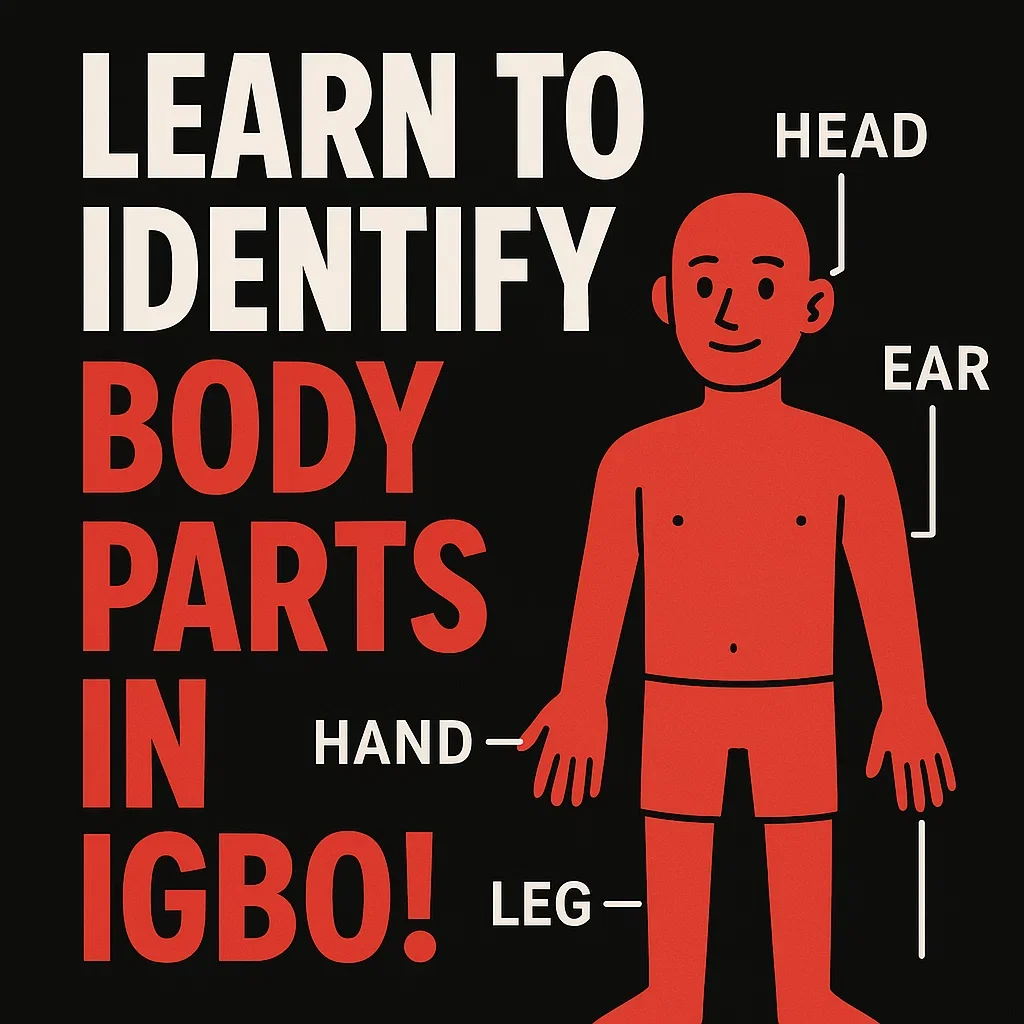
This teaching is focused on Knowing the body parts in Igbo language. At the end of the lesson, students should be able to know how to correctly identify the body parts in Igbo.

This teaching is a continuation on Words related to health, illness, and emergency in Igbo language. At the end of the lesson, students should be able to make sentences regarding health.

This teaching is a continuation on Words related to health, illness, and emergency in Igbo language. At the end of the lesson, students should be able to make sentences regarding health.

This teaching is focused on Words related to health, illness, and emergency in Igbo language. At the end of the lesson, students should be able to make sentences regarding health.
This teaching is on Words that describe directions, and places in Igbo language. At the end of the lesson, students should be able to make sentences with directions and locations.
This teaching is on Words that describe directions, and places in Igbo language. At the end of the lesson, students should be able to make sentences with directions and locations.
This teaching is on to Vocabulary related to daily activities, routines, and household chores in Igbo language. At the end of the lesson, students should be able to have basic day to day conversation.
This teaching is on to Vocabulary related to occupations and hobbies in Igbo language. At the end of the lesson, students should be able to have basic work related conversations.

This teaching is on to Vocabulary related to family in Igbo language. At the end of the lesson, students should be able to have basic family related conversations.

This teaching is on to Verb and Sentence Patterns for Expressing Actions in Igbo language. At the end of the lesson, students should be able to know how to express actions in Igbo.
Introduction to Subject-Verb Agreement and Word Order. At the end of the lesson, students should be able to know how to apply them in Igbo language
Introduction to verbs and verb roots in Igbo. At the end of the lesson, students should be able to know how to use verbs in Igbo language.
Introduction to Common adjectives and their usage. At the end of the lesson, students should be able to know what an adjective is in Igbo language.
Introduction to Common nouns and their usage. At the end of the lesson, students should be able to know what a noun is in Igbo language.
 Oma
Oma
21st-century Dibia (Igbo mystic).
Revisions and open discussions of main ideas covered in previous lessons under intermediate level. At the end of the session, students should be able to recall the most important ideas taught at Intermediate Level of this free Igbo language classes series.